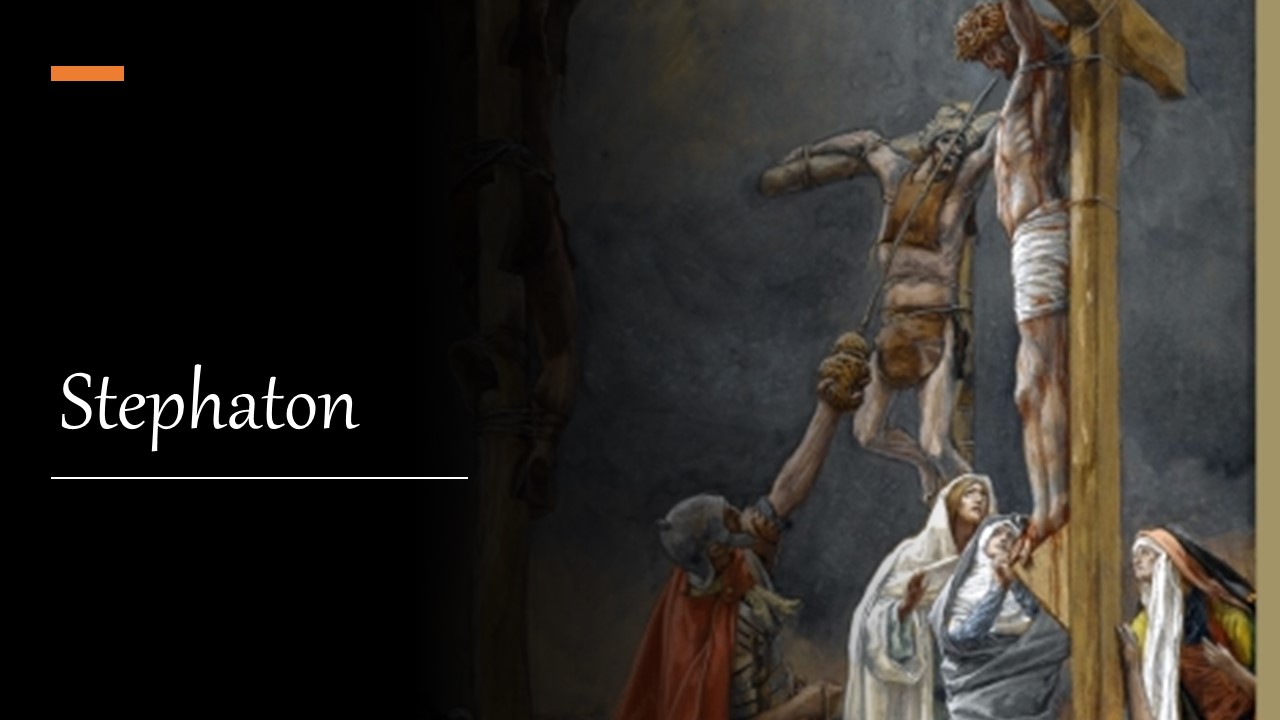
We continue with “Perspectives on Easter” – our series focused on the people who played both major and minor roles in the Easter narrative, as well as the relevant places, practices, artifacts, and traditions related to Easter. Today we feature a first person monologue from Stephaton, the name given in medieval Christian traditions to the Roman soldier or bystander, unnamed in the Bible, who offered Jesus a sponge soaked in vinegar wine at the Crucifixion..
The account of Jesus receiving a sponge soaked in vinegar while on the cross appears in all four of the canonical gospels, with some variation. In both Mark 15:35-36 and Matthew 27:47-48, just after Jesus says “My God, my God, why have you forsaken me,” a bystander soaks a sponge in vinegar and raises it on a reed for Jesus to drink. Luke 23:36-37 mentions that the attendant soldiers offer Jesus vinegar while mocking him. In John 19:28-30, Jesus declares "I thirst" (one of his last words) and is given the vinegar-soaked sponge "on hyssop". The significance of the act is unclear, though it is usually interpreted as an act of mercy on the part of the soldiers. The episode may allude to Psalm 68:22: “In my thirst they gave me vinegar to drink.”
Additional scriptures referenced include John 19:1-24, 31-35; Luke 22:47-53, 63-71; and Mark 15:16-20.

In today’s “Best of Replay,” we rebroadcast Episode 34 from December 2020: “It’s Easy to Miss Christmas.” This episode which references John 1:11 and...

In many traditions of the Church, there has been confusion and controversy about the roles of women in ministry. While people still debate what...

What does Exodus say about thriving? God gives the children of Israel the ten guidelines that are the basis of a 10-10 life. Rather...