As the last surviving member of the Twelve, John reflects on what it means not merely to survive but to “remain” as a calling. In youth, he wanted action, prominence, and a place near the center of the kingdom he expected Jesus to establish. Decades later, he understands that the center was never the dramatic moment but the truth to which those moments pointed, and that truth requires witnesses willing to carry it after the excitement has passed. Central to John's understanding is James, whose martyrdom showed him what it meant to drink the cup completely. John continues to carry his brother's example, confident because of the empty tomb that James's death was not the end of James and that their separation will ultimately end in reunion.
From the distance of old age and exile, John can also see the larger shape of a story that none of its participants fully understood while living through it. Peter, Thomas, Andrew, Salome, James, and John each saw Jesus from a different position, and each perspective revealed something the others could not. What John now sees beneath the miracles, arguments, failures, corrections, deaths, and restorations is love. The world repeatedly tried to contain Jesus within familiar categories such as teacher, prophet, king, or revolutionary, but none was sufficient. John's decades of reflection have led him back to the conviction at the heart of his Gospel: in Jesus, the eternal Word became flesh, and divine love entered human experience in a form that could be seen, heard, touched, rejected, crucified, and yet could not be overcome.
In the closing moments, John recognizes that his vocation on Patmos resembles Salome's lifelong vocation of watching from the edges. She observed Jesus and her sons from a place no one else occupied, preserving truths visible only from her particular vantage point; now John does the same as the last keeper of memories that would otherwise disappear with him. The thunder that once expressed itself through youthful ambition has passed through suffering, service, martyrdom, grief, writing, and witness until it has become testimony traveling from generation to generation. Looking back to the boy beside the Galilean lake who did not yet know what he was seeking, John realizes that he has finally found it, not as a destination but as a life lived within the inexhaustible love he spent decades trying to understand. With nothing left to prove and nothing left to seek apart from the One he has followed all his life, the last Son of Thunder ends where his final vision ends: “Come, Lord Jesus.”
The psalms comprise the ancient hymnal of God’s people. They express emotions to God or about God. We wrap up our week-long study with...
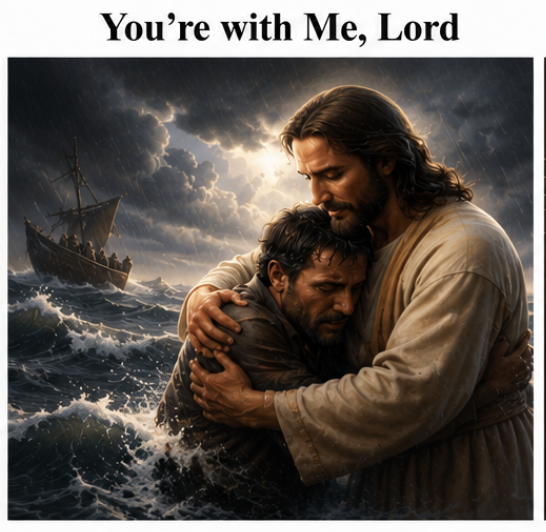
Inspired by Henry Francis Lyte’s beloved hymn “Abide with Me,” today’s episode explores one of Scripture’s most reassuring promises: God is with us. Lyte...

We kick off a brand new holiday special today, entitled The Innkeeper's Wife. The first episode immediately establishes a tone of weary exhaustion and...